




THE L-ARC™ FRAMEWORK

The problem is not detection.
The problem is permission.

L-ARC™ bridges the gap between emerging risk intelligence and preventive action by connecting evidence, governance legitimacy and sustainable investment, enabling institutions to act responsibly before visible harm makes intervention unavoidable.

Three Connected Institutional Capabilities

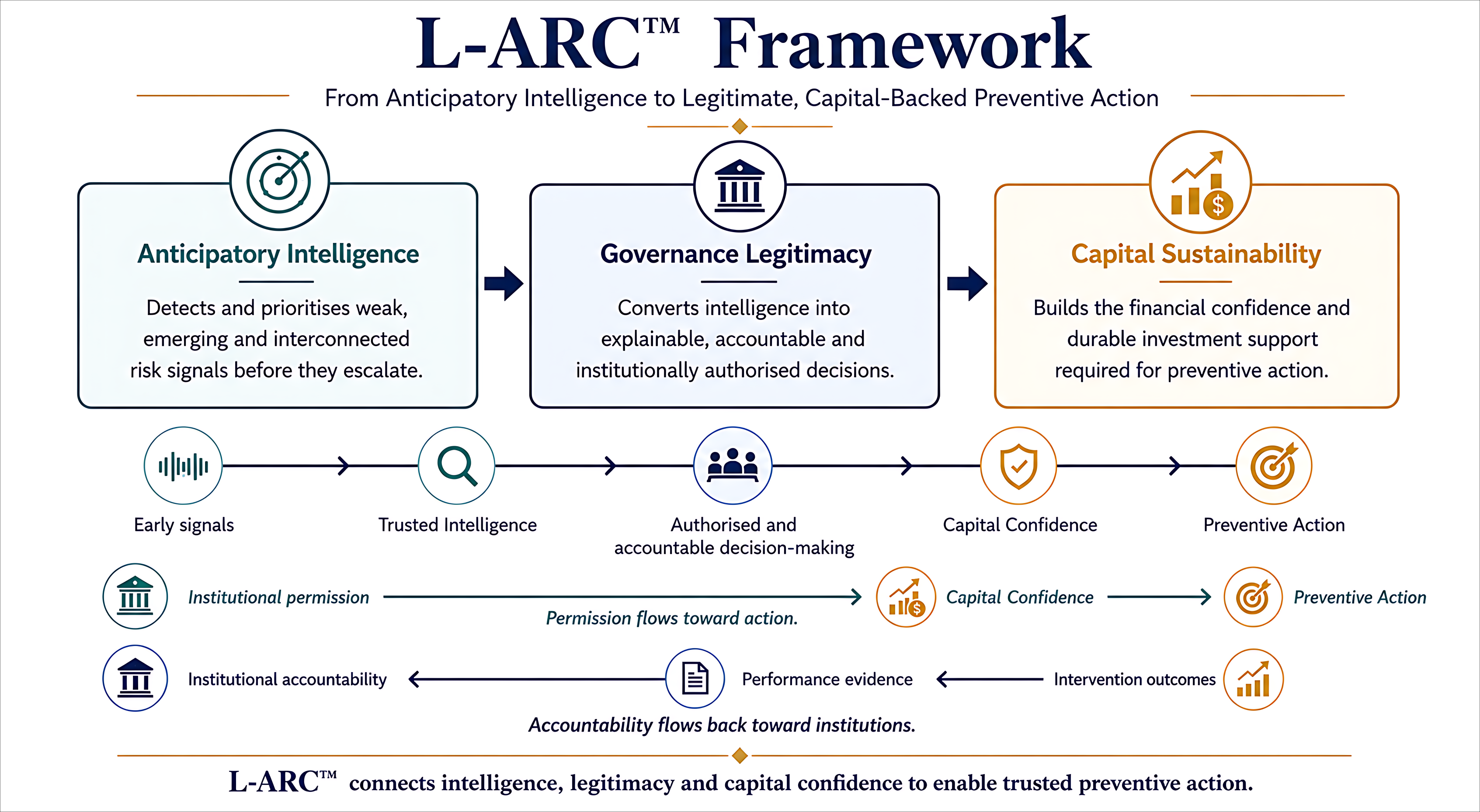
The conceptual framework is built around three constructs. Together, they explain what institutions require to transform intelligence into accountable preventive action.

L-ARC Framework detailed process flowchart mapping
Click to Zoom
Pet protection default blue icon Pet protection interactive gold icon

Anticipatory
Intelligence

Pet protection default blue icon Pet protection interactive gold icon

Governance
Legitimacy

Pet protection default blue icon Pet protection interactive gold icon

Capital
Sustainability

Anticipatory Intelligence

Anticipatory Intelligence is the capacity to recognise, contextualise and prioritise risk before it becomes severe disruption or irreversible harm.

It may draw on:

  • environmental and weather observations;
  • satellite and UAV imagery;
  • utility and infrastructure telemetry;
  • IoT and edge sensors;
  • maintenance and inspection records;
  • vegetation and biodiversity indicators;
  • acoustic and visual evidence;
  • field intelligence;
  • community and local knowledge.

The purpose is not perfect prediction. It is to make emerging risk visible early enough for prevention to remain possible.

Key question

What is beginning to change, and can the institution understand it before the consequences become unavoidable?

Governance Legitimacy

Governance Legitimacy determines whether intelligence and intervention are explainable, authorised, proportionate, ethical and institutionally defensible.

It connects risk intelligence with:

  • decision ownership;
  • human review;
  • explainability;
  • escalation pathways;
  • confidence and uncertainty;
  • policy and regulatory alignment;
  • audit evidence;
  • community and stakeholder trust;
  • accountable leadership.

Technical accuracy alone does not create legitimate action. Institutions must be able to explain why action is justified, who authorised it and how responsibility will be maintained.

Key Question

Is the decision sufficiently trusted, authorised and accountable to support action under uncertainty?

Capital Sustainability

Capital Sustainability is the capacity to connect preventive resilience with long-term institutional, financial, environmental and public value.

It brings together:

  • avoided harm and avoided loss;
  • infrastructure reliability;
  • operational continuity;
  • insurance confidence;
  • regulatory exposure;
  • ESG and sustainability value;
  • biodiversity protection;
  • public value;
  • reputation;
  • long-term capital discipline.

Prevention should not be treated merely as expenditure. It should be assessed as a disciplined investment in continuity, legitimacy and avoided harm.

Key Question

Can preventive action be justified, financed and sustained before disaster proves its value?

From Early Signals to Preventive Action

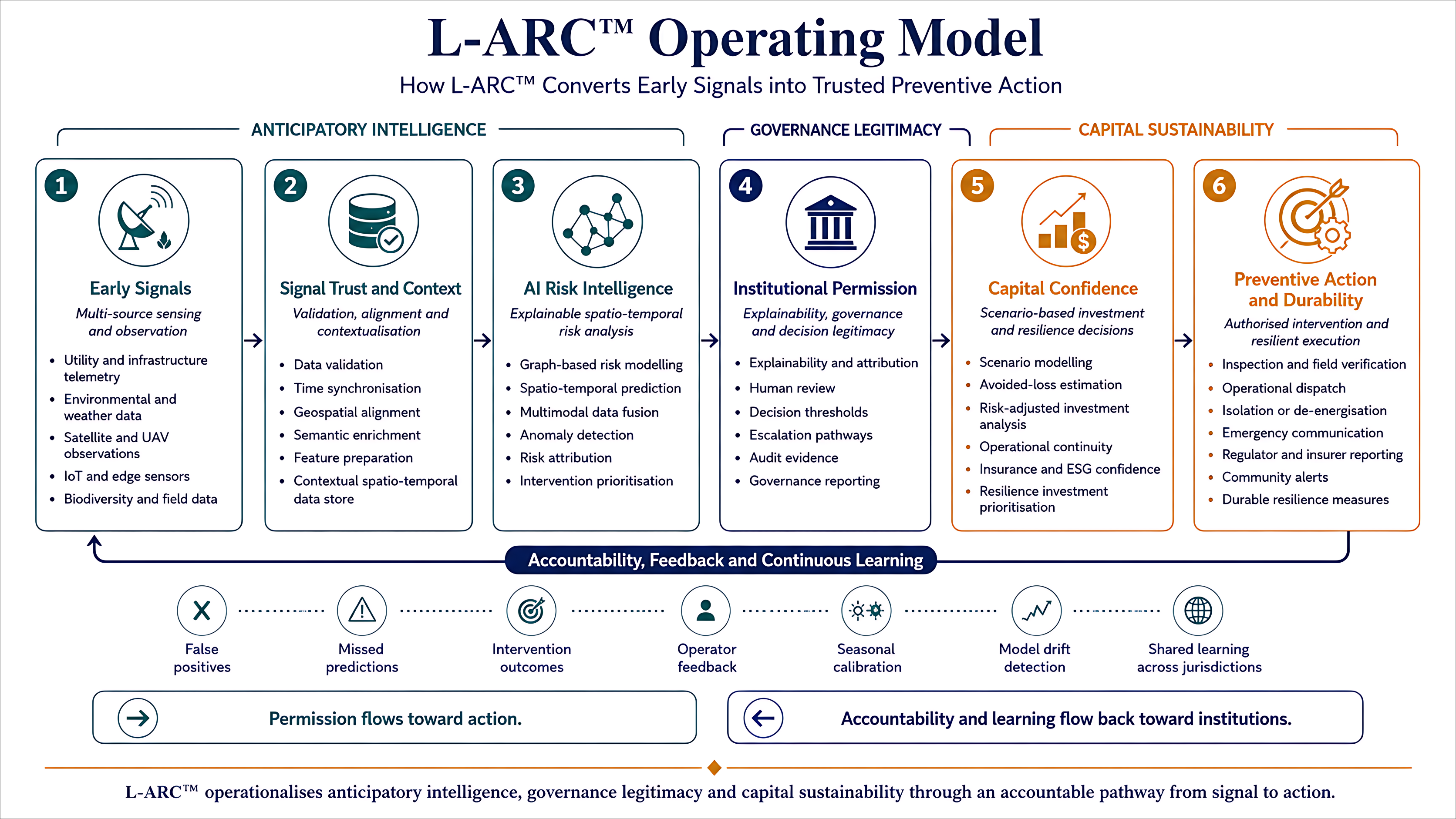
The L-ARC™ Operating Model translates the three conceptual constructs into a six-stage pathway. It connects sensing, contextualisation, intelligence, institutional permission, capital confidence and execution while embedding accountability and continuous learning

L-ARC Framework detailed process flowchart mapping
Click to Zoom

A feedback pathway must return from outcomes to institutional learning, data quality, model calibration, governance thresholds and future investment decisions.

Early Signals

The operating model begins by detecting meaningful change across natural, built and operational systems.

Potential sources include:

  • environmental and weather observations;
  • infrastructure telemetry;
  • satellite and UAV data;
  • IoT and edge sensors;
  • biodiversity observations;
  • maintenance records;
  • community and field intelligence.

The purpose is not simply to collect more data. It is to identify patterns that may indicate emerging risk.


Signal Trust & Context

The Raw observations may be incomplete, inconsistent, delayed or disconnected from place and time.

This stage builds trust through:

  • data validation;
  • time synchronisation;
  • geospatial alignment;
  • calibration status;
  • semantic enrichment;
  • contextual metadata;
  • feature preparation;
  • spatio-temporal storage.

The result is an evidence base that is sufficiently reliable and interpretable for further analysis.

AI Risk Intelligence

Trusted signals are analysed across space, time, assets, environments and operational dependencies.

Potential capabilities include:

  • graph-based risk modelling;
  • spatio-temporal prediction;
  • satellite and UAV data;
  • multimodal data fusion;
  • anomaly detection;
  • probabilistic risk assessment;
  • risk attribution;
  • intervention prioritisation;
  • scenario comparison.

The objective is not only to estimate what may happen, but also to explain why risk is changing and what actions may reduce it.

Institutional Permission

Institutional Permission is where risk intelligence enters a governed decision environment.

This stage may include:

  • explanation and attribution;
  • human review;
  • uncertainty communication;
  • decision thresholds;
  • ownership and escalation;
  • policy and regulatory alignment;
  • audit evidence;
  • community and stakeholder considerations.

The output must be an authorised institutional decision—not an ungoverned algorithmic recommendation.

Capital Confidence

Approved intervention options are assessed for feasibility, value and durability.

This may include:

  • scenario modelling;
  • avoided-loss estimation;
  • risk-adjusted investment analysis;
  • operational-continuity assessment;
  • insurance implications;
  • ESG and public-value considerations;
  • resilience-investment prioritisation.

Capital Confidence makes preventive action fundable, explainable and institutionally defensible.

Preventive Action & Durability

The operating model culminates in authorised action.

Depending on the context, intervention may include:

  • inspection and field verification;
  • operational dispatch;
  • isolation or de-energisation;
  • vegetation or habitat management;
  • emergency communication;
  • community alerts;
  • infrastructure upgrades;
  • regulator and insurer reporting;
  • long-term resilience measures;

The objective is not only immediate intervention. It is sustained reduction of vulnerability, exposure and future loss.

Permission flows downward. Accountability flows upward.

Senior leaders must create the conditions that allow teams to act early. They provide mandate, governance, funding logic, escalation pathways and protection for responsible decisions under uncertainty.

Accountability must simultaneously remain visible and traceable. Decisions should be explainable to boards, regulators, insurers, communities and the public.

Within the operating model, this becomes:

Permission flows toward action. Accountability and learning flow back toward institutions.

From Framework to Implementable Architecture

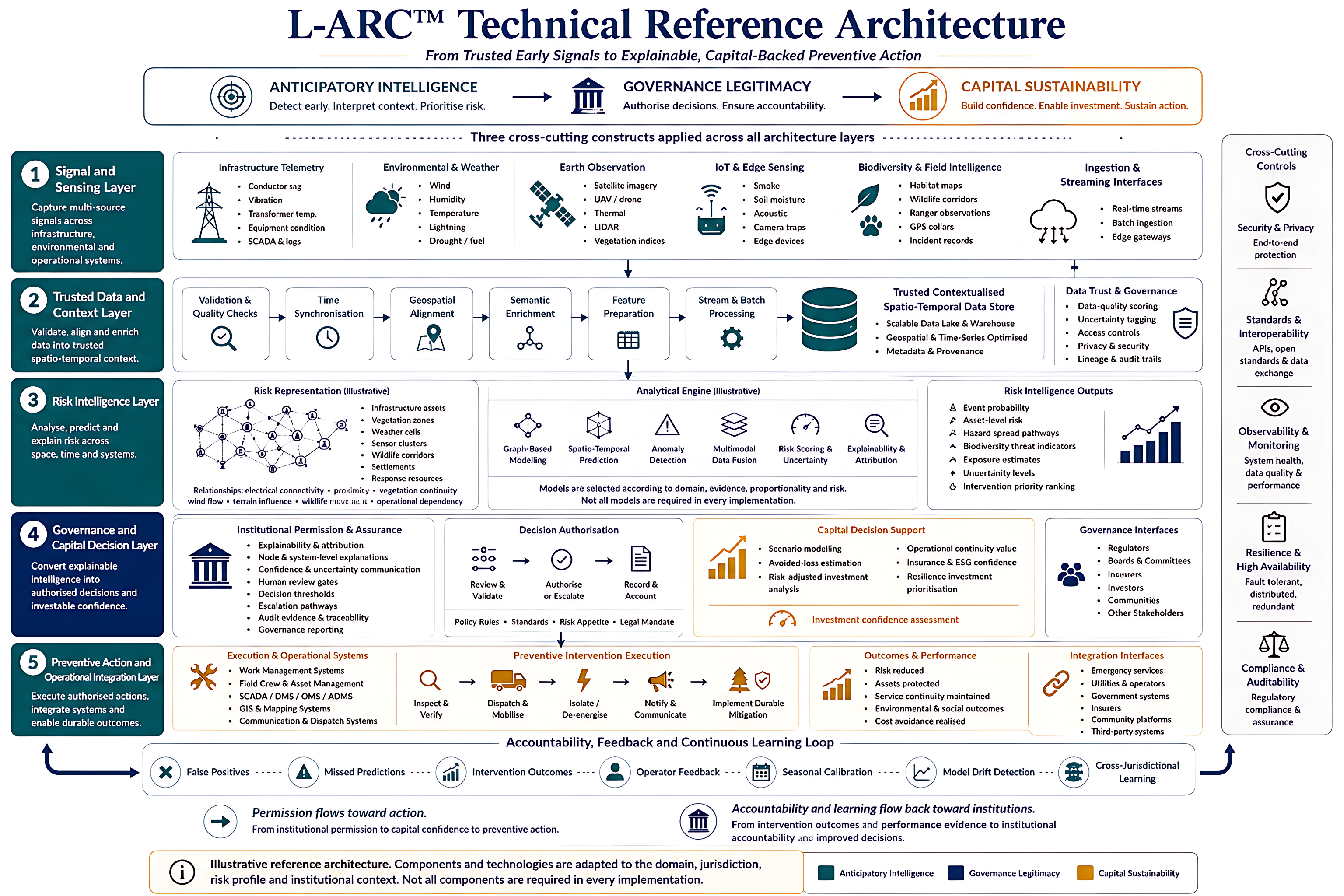
The L-ARC™ Technical Reference Architecture illustrates how the framework may be implemented across technical systems, institutional controls and operational environments.

It is not a mandatory technology stack. It is an adaptable reference structure for different sectors, jurisdictions and levels of risk.

L-ARC Framework detailed process flowchart mapping
Click to Zoom

L-ARC™ helps institutions act before crisis creates permission.